
In addition to the natural exoticism, Larantuka promises the uniqueness of the Lamaholot tribe’s culture. The assimilation of Christian traditions introduced by the Missionaries with local culture has left traces of religious practices that blend with the lives of the Lamaholot ethnic community in the Semana Santa celebration – a celebration of Holy Week culminating in Easter. In this Holy Week, Larantuka Catholics celebrate and reflect on the suffering of the Lord Jesus in a unique way. Semana Santa is a Catholic Easter celebration which uniquely combine Portuguese cultural heritage with the local traditions of the Lamaholot tribe in Larantuka. For centuries the Semana Santa has attracted thousands domestic and foreign pilgrims and tourists. The Catholics come to the city to join the whole rites and procession. Instead of Catholic pilgrims, tourists from various religious and cultural backgrounds come to experience something unique and extraordinary.
Spiritual Path in Larantuka
Pilgrims and tourists come to the city of Larantuka and become increasingly crowded since the week before Easter. However, pilgrims will follow the complete cycle of Samana Santa and its rituals if they come to Larantuka on Tuesday as there will be rites of Tikam Turo in the afternoon – where the Catholics in Larantuka setting up the fence on the side of procession route and built the Armidas. And the next day, right on Wednesday (Rabu Trewa), there are series of events begin with the Lamentation of Wednesday Trewa and the ritual of blessing the procession route. Furthermore, a series of devotional reflection activities, processions and celebrations of the Holy Thursday Eucharist are followed by the peak event of the Good Friday procession.
The city of Larantuka can be accessed by flight with transit in Kupang or transit in Labuanbajo then continue fly to Maumere and take a 3-hour land trip from Maumere to the city of Larantuka. Although pilgrims and tourists can come last minutes to Larantuka while the series of events begin, it must be ensured that your accommodation has been booked far in advance. It’s hard to find accommodation last minutes, as hotels and home stays and even local people’s houses are always fully booked during the Easter Season.
In case visitors choose to arrive in Larantuka city prior to the event, there will be lots of opportunity to have visit to some tour attractions in the city and beyond. Lewokluok, the most attractive traditional village of the Lamaholot tribe in the West of Larantuka with its unique weaving, which is unlike other weaving, produced by weavers who combine cotton thread with beautifully woven shells to form a unique ikat motif. Another option to take is to visit and pray on a stunning sea view park at the Taman Doa Bukit Fatimah. Visiting to the Chapel of the Bishop Gabriel Manek, SVD could be an introductory pilgrimage. Bishop Gabriel Manek, an indigenous Bishop who founded the Congregation of nuns of the Daughters of Reinha Rosari (PRR); died and was buried in the United States of America. After a long period of time his tomb was exhumed in order to take his bones to be brought back to Larantuka. But, what a miracle happened! The body of the Bishop was found intact-without damage. Now the body of the Bishop is laid in a coffin that’s kept in a small chapel in the city. The visitors are allowed to pray at Bishop Gabriel’s coffin with personal intentions and special requests. There are many testimonies of Catholic faith where prayers and special intentions are answered in prayer at this place.
For the procession activities, pilgrims need to register themselves as participants in the pilgrimage and Good Friday procession. Registration is usually served at the Reinha Rosari Cathedral Church and participants who have registered will be provided with a keplek and guidebook and schedule of the event. Registration is important as the way to control participants in participating in the sea procession on Good Friday which not to be exceed the ship’s carrying capacity.
Maundy Thursday
There are not many activities in the morning. Pilgrims will choose to pray in the church and chapel waiting for the moment to visit to Senhor Chapel in Wure of Adonara Island to attend the veneration of the Lord Jesus who was experiencing torture and suffering. This rite is performed at the Senhor Chapel in Wure where the Standing Lord Statue is enthroned. The figure of Jesus is crowned with thorns and his face is covered in blood. Usually pilgrims are crowded in long lines under the scorching heat all day long. The best option to do this pilgrimage is in the evening to avoid long queues and the scorching midday sun. Participants require to take a boat from Larantuka to Adonara Island. It takes just about fifteen minutes on boat to reach the western edge of Adonara Island. During Holy Week, it is usually filled with pilgrims in a long queue starting from the port to the Senhor Chapel in Wureh. Well, in here since entering the Chapel door, all pilgrims walk on their knees along the carpet path leading to the place of the enthronement of Standing Lord Statue.
There are several statues and sacred objects from the past inside the chapel. The main one is the two-meter-high statue of Lord Jesus crowned with thorns. Then there is a statue of the body of Jesus lying in a bier. The ritual performed is paying a respect and praying near the statue of Lord with deep suffering figure.
From Adonara Island, the journey continues by boat to the Chapel of Tuan Meninu in Larantuka. Pilgrims come to perform the same ritual, walking on our knees and paying a respect to and pray to Tuan Meninu (statue of the child Jesus). In addition, pilgrims are invited to join the ritual of praying for the souls of those who have passed away, where pilgrims will pray for all relatives who have died and also victims of accidents in sea processions several years ago and pray that the ceremony tomorrow Friday will run smoothly and safely. One part of this ritual is the throwing of flowers and candles into the sea which are delivered by boat to the middle of the sea.
At nightfall, pilgrims will attend the celebration of Maundy Thursday mass to commemorate the event of Jesus having the Last Supper with His disciples, establishing the sacred tradition of the Eucharist and teaching of serve others through the acts of the washing of the feet of His disciples.
Good Friday
This day is the peak moment of reflection. In the morning, Catholics have been prostrating and praying at the Tuan Ma Chapel where the statue of the Virgin Mary the historical relic is enthroned. Pilgrims queue up to wait for their turn to enter to express their prayers and personal intentions there likewise at the Tuan Ana Chapel where the statue of Jesus was enthroned. At around 10:00 there will be a Sea Procession. Pilgrims will take part in the sea procession. Pilgrims need to go to the harbor to report and register of participating in the sea procession. Ships are strictly monitored in relation to the number of passengers and to be limited only for the registered one to avoid overloading.
In this sea procession, pilgrims cruise to accompany Tuan Meninu across the sea from the Tuan Meninu Chapel to Pante Kuce at Pohon Sirih. The Tuan Meninu statue is paraded using a rowed boat escorted by ten other rowed boat. They must row through the ocean. While pilgrims are allowed to board a motorboat, however the position of the motorboat must not precede the main boat carrying the Tuan Meninu Statue and the ten others. The rowed boats moved very slowly escorting the statue of Tuan Meninu, so that it would finish in after noon.
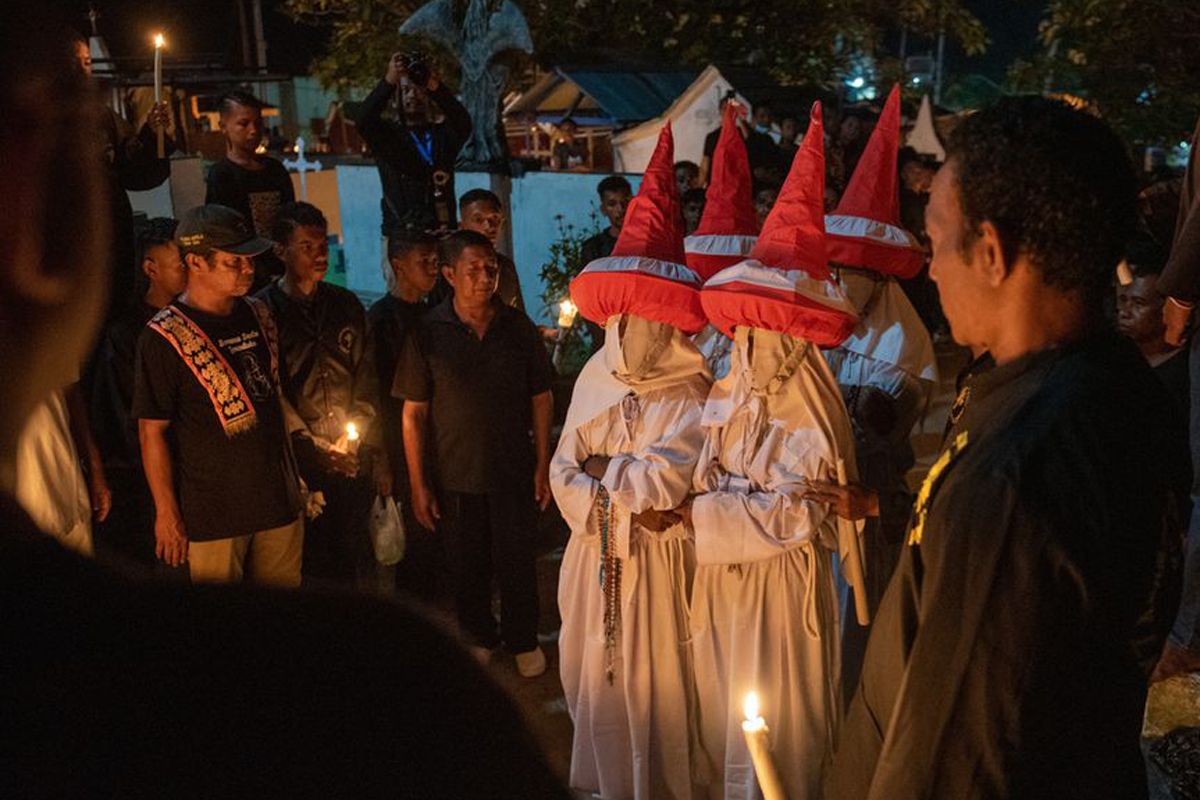
In the evening, pilgrims will again participating another rite in the Good Friday procession. The Catholics and the pilgrims will walk together escorting the statues into the Cathedral Church. This is followed by the Good Friday service or the commemoration service for the death of Jesus. This ritual is the same as that carried out in the universal church, namely the ceremony of the story of the passion of Jesus and the ceremony of venerating the cross.
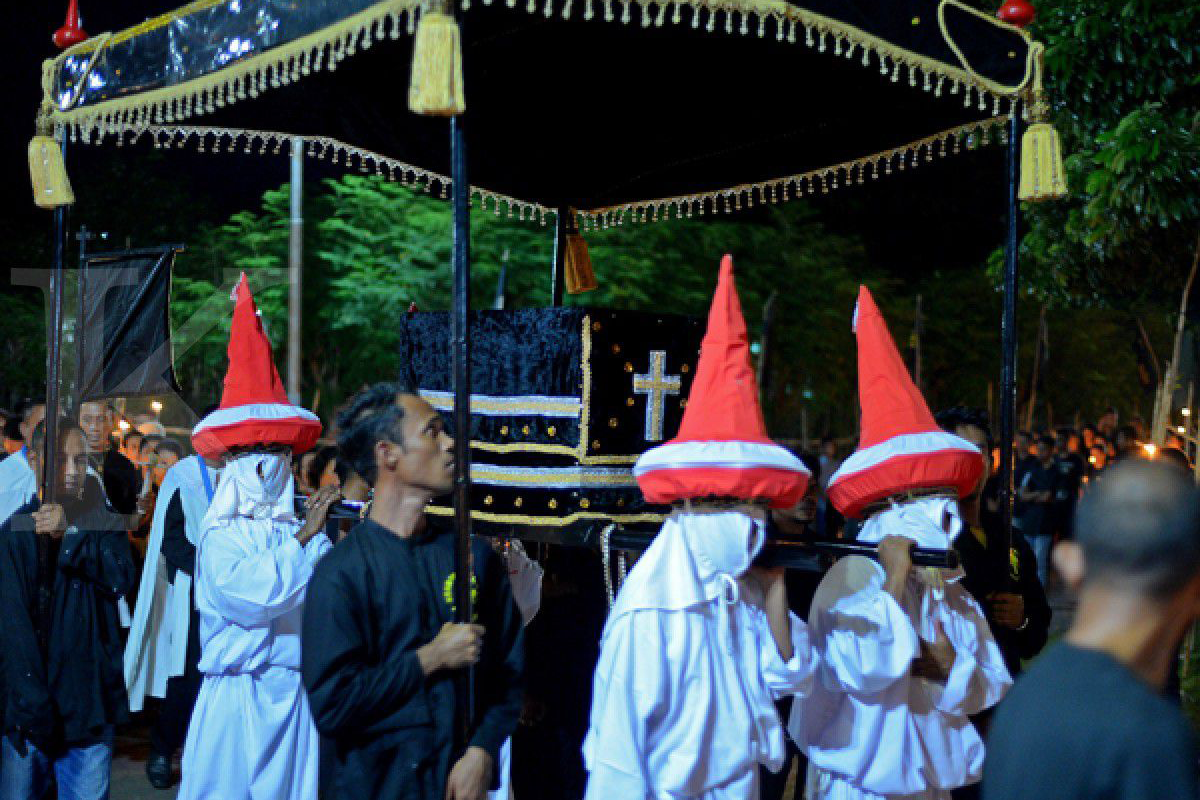
And afterwards continued with the Good Friday Lamentation at the Cathedral Church. Lamentation is a prayer and song of lamentation that culminates with the chanting of Ovos sung by a woman as a song of lamentation of the Virgin Mary for the death of Jesus. This event will be continued with the ceremony of carrying the coffin of Jesus by four Lakademus dressed in white and wearing red hats whose faces are covered not to be recognized. Lakademu are usually appointed with great secrecy in turns every year to carry the coffin of Jesus to be paraded around the city. The entire congregation and even among them do not recognize who is on duty and they must keep themselves a secret. The appearance of Lakademu marks the beginning of the Good Friday Procession. Tuan Ma and Tuan Ana are carried by Lakademu and paraded around the city of Larantuka, passing eight Armidas (stopping points for life reflection). The pilgrims pray and sing songs of mourning throughout this procession. And at each Armida the congregation will stop to reflect on the event of the suffering of the Lord Jesus and reflect it for each personal life. Thousands of candles are lit along the procession route and also in the hands of each pilgrim coloring the situation of great holy mourning.
Holy Saturday
On Saturday there are not many events. Everyone stayed indoors or in churches and chapels to pray and mourn the suffering and death of Jesus. This mourning will close with the Holy Saturday Mass (Easter night) marked with a great Easter Candle to remember the light that conquered darkness, Jesus rose to overcome all suffering and death and sin. The ritual of Light is the same as the Catholic ritual of Light in all universal churches.
Easter Sunday
On this Easter Sunday, pilgrims unite with the Universal Catholic community to celebrate Holy Easter as usual.
Pilgrims can choose to celebrate Easter in the city of Larantuka or they can also celebrate it in other Catholic churches around Larantuka or in the city of Maumere and continue your holiday with cultural and natural tourism trips that are no less touching to the soul. (Adh)
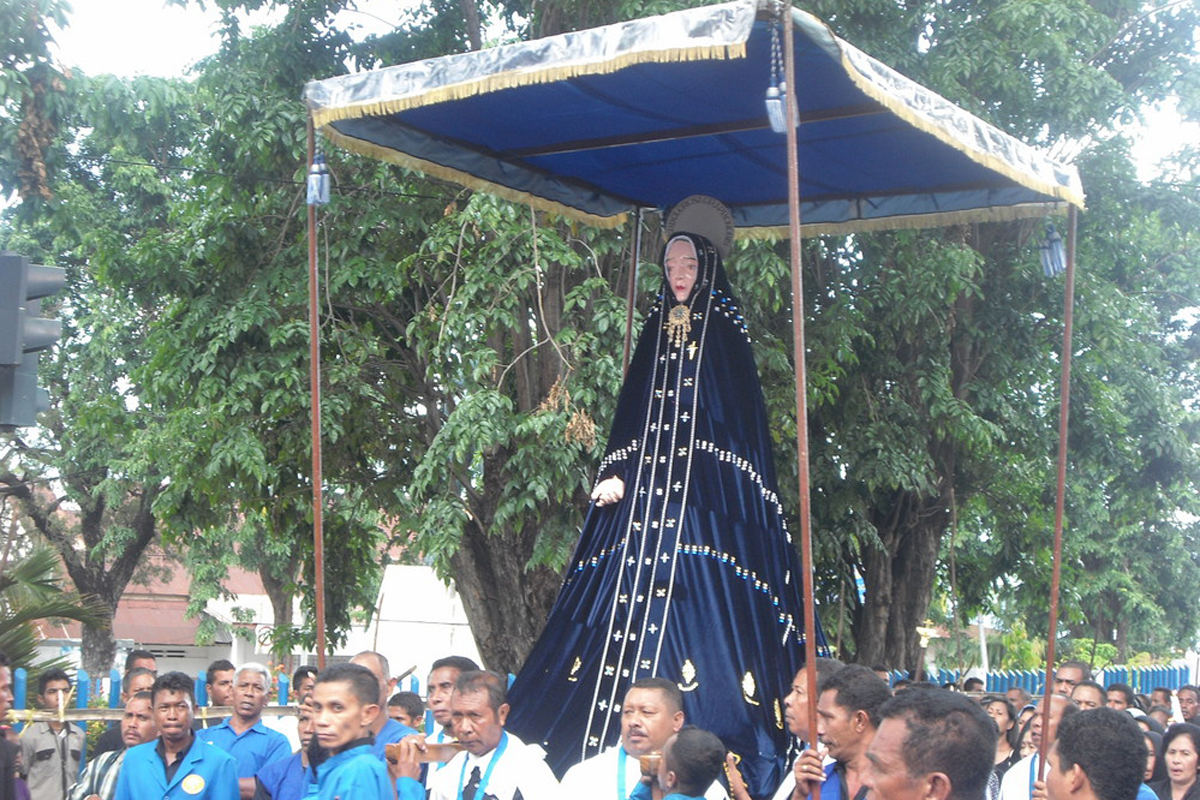
The history of the Semana Santa tradition began about 500 years ago when a young man from the Resiona Tribe was playing on the beach of the sea and suddenly saw a most beautiful lady like goddess walking on water. In his curiosity the Resiona youth then asked to the goddess, but was answered in incomprehensibly strange language. The youth then reported what he had just experienced to the tribal elders. Hearing the report, the tribal elders flocked to the place where the Resiona youth saw the beautiful goddess. However, when they arrived at the place, there was only a statue of a beautiful woman. They then took the statue of the woman and placed it in the korke (traditional house of the Lamaholot Tribe).
The Larantuka community, who at that time still adhered to animism and dynamism, considered the statue to be a sacred object. So the statue that was enthroned in the korke (traditional house) was highly respected like a goddess. The Lamaholot people who inhabit the coast of Flores always pray in front of the statue when they want something, such as a request for an abundant harvest, a request for healing, and even a prayer ritual before war. And as if it were a power in itself, the community felt that their requests were always granted. The local community eventually called the statue Tuan Ma, which literally means Tuan Ma and Mother. Meanwhile, the Lamaholot community called it Rera Wulan Tanah Ekan or the God of Heaven, the God Universe and the God of Earth.
In the 16th century, along with the arrival of Portuguese traders in Flores, missionaries also came to spread the Catholic religion. The King of Larantuka then invited the missionary to see the holy figure who is now known as Tuan Ma. After realizing that the writing near the figure stated “Santa Maria Reinha Rosari”, the missionary immediately knelt down when he realized that the figure was actually the Virgin Mary. The missionaries realized then convinced that the Virgin Mary ‘Santa Maria Reinha Rosari’ had preceded and paved the way for their mission works on land of Flores.
In 1650, the King of Larantuka Ola Adobala was then baptized as a Catholic and entrusted his kingdom and power to the protection of Tuan Ma. All members of the royal family and the surrounding community also converted to Catholicism. By entrusting the power and kingdom to the protection of Queen Rosario, Larantuka was called Kota Reinha (Portuguese) which means City of Queen Mary.
Afterwards In 1665, the son of Ola Adobala, Don Gaspar I, began to parade the statue of Tuan Ma around Larantuka so that all people would also ask for protection for the kingdom and the city of Larantuka. The tradition of the Semana Santa was then practiced from generation to generation which still survives to this day. Local Catholic Church supported this tradition as a practice of faith that grows in the local culture of the Lamaholot community in Larantuka. (Adh)



By Gema Pariwisata Svarga (Persero)
Flores' Top Points
Comapany's Legal Standing
WhatsApp us


