HomeAttractionsThe Captivating Kelimutu Lakes: Ever-changing Color
The Captivating Kelimutu Lakes: Ever-changing Color
Flores Tourism Service
February 28, 2025
Share
Facebook
Twitter
LinkedIn
Pinterest
The three Kelimutu crater lakes can be seen well from Tugu Puncak (1,647m asl) which is located next to Mount Kelimutu. It takes approximately 30 minutes to get there on foot through a well-groomed path that leads visitors to the spot. The unique quality of Kelimutu Crater Lakes is the color of the water in the craters that keeps changing from time to time. The change in the water color in all three crater lakes indicates ongoing volcanic activity and changes in the mineral content of the volcano. As to when the color change started to occur is not clearly known. However, when Van Such Telen (a Dutch citizen) first arrived at the peak of Kelimutu in 1915, the water color change was observed and recorded.
Tiwu Ata Polo
The lake situated in the southeast is the largest of the three. Tiwu Ata Polo occupies an area of 4 hectares and is 64 meters deep. The Lio community named the lake Tiwu Ata Polo. It was recorded that from 1915 to 1951 the lake was consistently bright red in color, but then the color changed to maroon in 1958 up until 1960. In 1968 through 1980, the lake turned to brownish red. Next, in 1984, Tiwu Ata Polo changed its color again to dark green and stayed that way until 1987, after which the color faded to light green in 1990. Then, in 1992 the bright red color returned. In1995 the lake still retained its red color only that it was slightly darker. Throughout the period of 2002 to 2008, the color of the lake’s water remained the same, which was brown, and then changed to green in 2011, and then changed again to moss green in 2015. Today, Tiwu Ata Polo has turned light green. The Lio people believe that Tiwu Ata Polo is a place where the spirits of evil people dwell.
Tiwu Nuwa Muri Ko’o Fai
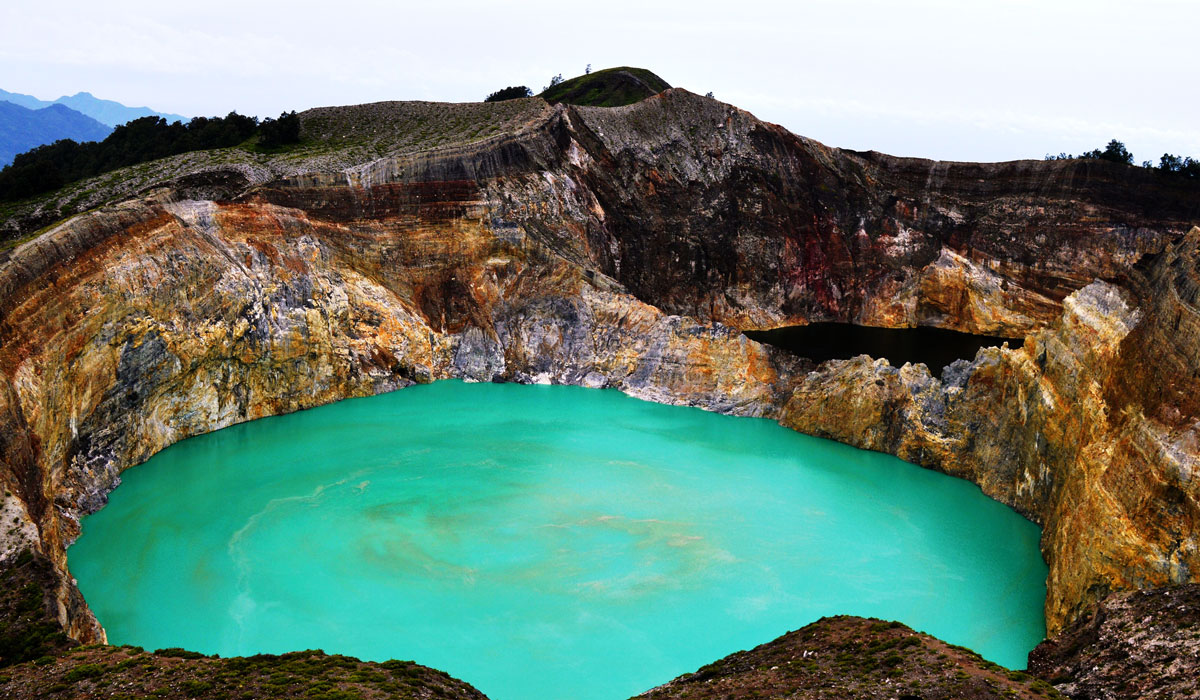
The Tiwu Nuwa Muri Ko’o Fai lake is situated in the middle between Tiwu Ata Polo and Tiwu Ata Bupu, and separated by a very thin line from Tiwu Ata Polo. Literally, the name of the lake means ‘the lake of young men and women’ or the lake of the youth. Tiwu Nuwa Muri Ko’o Fai has an area of 5.5 hectares and is 127 meters deep. Compared to the other two lakes, this lake rarely changes color. It was recorded that in 1915 the lake was turquoise in color and then turned dark green in 1929. In 1940, the lake turned greyish white. In 1951, the water in the Tiwu Nuwa Muri Ko’o Fai crater changed its color to dark green, and then in 1958 the color faded to light green. In 1960, the color turned sky blue and in 1968 it changed again to milky white before turning into light blue again in 1980. Four years later (1984),the color changed again to dark green, and then in 1987 the color faded to light green. The light green color lasted until 1990. In 1992, the color changed to turquoise and in 1995 it turned light green again, but in 2002 the color became deeper and changed to dark green. In 2008, it changed again to bluish pale green. In 2011, the color became grey, and then in 2015 the color became bluish white. Currently, Tiwu Nuwa Muri Ko’o Fai is bluish green (turquoise).
Lake Ko’o Fai Nuwa Muri has the lowest pH among the three, which is 0.37. The Lio community believes that Tiwu Ko’o Fai Nuwa Muri is a place where young spirits reside.
- Tiwu Nua Muri Koo Fai side by side with Tiwu Ata Polo -
Tiwu Ata Bupu
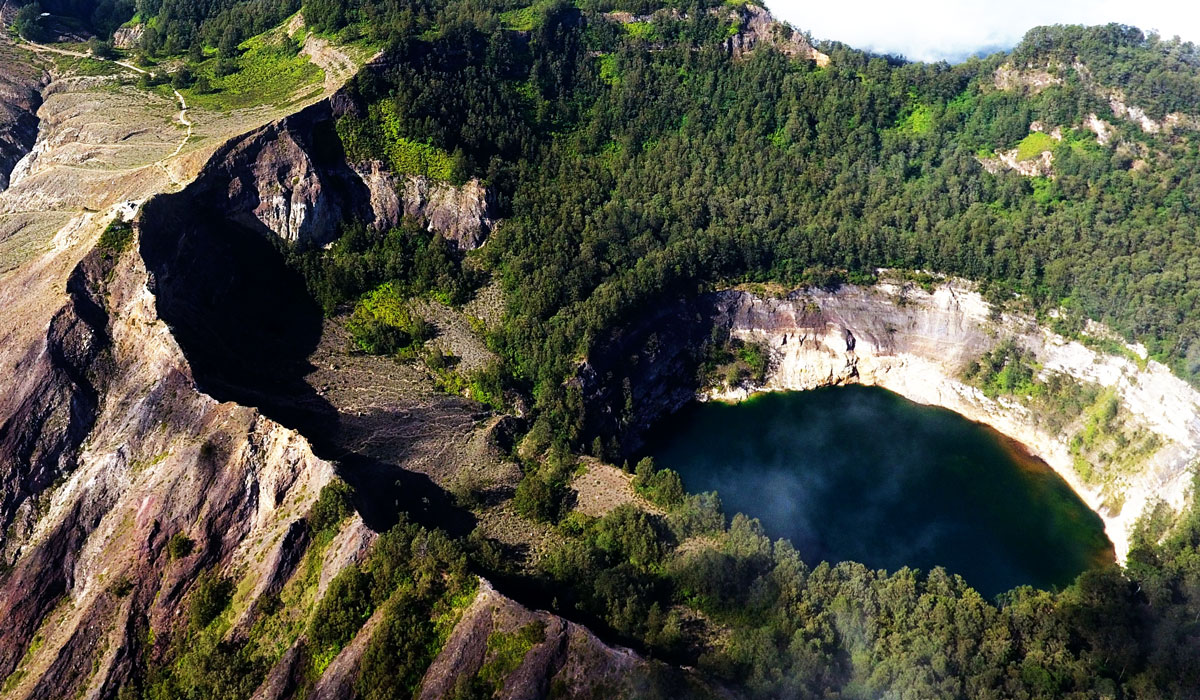
This lake is located about 500 meters apart from the other two lakes. The 4.5 ha lake with a depth of 67 meters is called Tiwu Ata Bupu and is recorded to have frequently changed its color to white, green, blue, grey, moss green, brown, and black. In 1915, the lake was milky white. Then, in 1929, the color changed to bluish green. This color lasted long enough until 1940. In 1951, the lake changed its color to light blue and it lasted until 1958. In 1960, the color of the water changed again to greyish white. In 1968, Tiwu Ata Bupu changed its color again and this time to moss green. Then, in 1980 the lake turned pitch black. In 1984, the color changed to deep red and it stayed until 1987. In 1990, the water color became pitch black again and in 1992 it returned to dark green. In 1995, the water of Lake Tiwu Ata Bupu turned brown. In 2002, the lake water turned black again. In 2008, Tiwu Ata Bupu turned to dark green again, and then in 2011 it faded to light green, and then it returned to dark green in 2015. Today, the Tiwu Ata Bupu lake is green moss.
This lake has the highest pH among the three, namely 3.02. Tiwu Ata Bupu has a depth of 67 meters and an area of 4.5 hectares. The people of Lio believe that this lake is a place where the spirits of the elder and wise people reside.
- Tiwu Ata Bupu -
The best time to see these three lakes is in the morning at around 5.30 a.m., when visitors can see not only the lakes but also the beautiful sunrise. Visitors can come after that time too. The inspiration point on the top of Kelimutu mountain also offers a spectacular view of the sunset.- (Adh)
 Flores Tourism Service
February 28, 2025
Flores Tourism Service
February 28, 2025